
How to find out what your Year 7 students actually know
Mon 19th Jan 2026
September arrives quickly. You have a new Year 7 class, end-of-KS2 SATs results somewhere in a spreadsheet, and very little time. The data tells you who hit the expected standard last summer. What it does not tell you is where the gaps actually are right now, or which students have already forgotten skills they appeared to have mastered in Year 6.
The most common mistake secondary maths teachers make in the first half-term is skipping this step. It is understandable: there is a curriculum to cover, and diagnostic work feels like a detour. But starting intervention without reliable information almost always means pitching it too high for some students or wasting time on ground that does not need covering.
Why SATs results are not enough
KS2 results give you a scaled score and a broad attainment band. They do not tell you whether a student who hit the expected standard can reliably multiply fractions, recall multiplication facts under time pressure, or work with negative numbers without a calculator. Nor do they tell you anything about the student who missed the standard by a small margin but has solid number sense in some areas and significant gaps in others.
What you actually need at the start of Year 7 is a quick, reliable way to see where each student sits across the core KS2 arithmetic curriculum, so that any pre-teaching work is targeted from day one.
A practical starting point
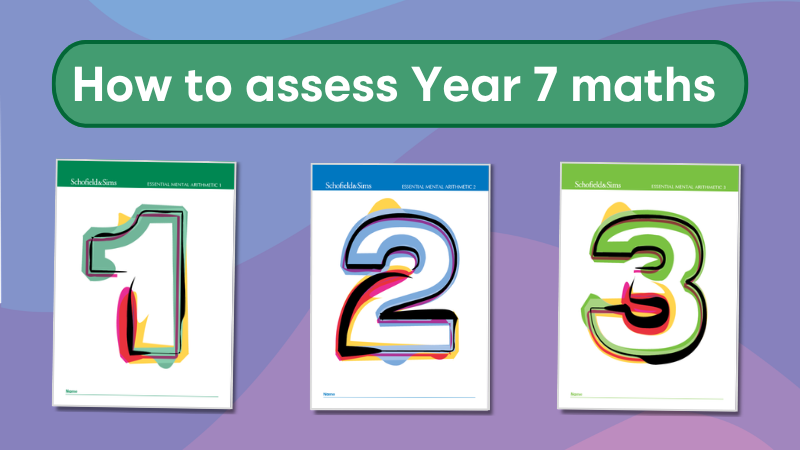
The entry tests in the Essential Mental Arithmetic series were designed for exactly this situation. There are two versions: Entry Test A, for students working at a lower KS2 level, and Entry Test B, for those working at an upper KS2 level. Both are free to download and take around 15 to 20 minutes to complete.
----------------------------------------
[Download the free Year 7 maths Entry Test Guide]
---------------------------------------
The results tell you where to place each student in the six-book series, so that practice begins at the right level rather than the assumed one. Students working through books that are genuinely matched to their starting point build fluency far more quickly than those placed in a one-size-fits-all group.
What to do with the results
Once you have entry test data, you have the basis for flexible grouping within a class or year group. A few things are worth bearing in mind:
- Groups do not need to be fixed. A student may move up once they have consolidated earlier skills.
- Short, daily sessions of 10 to 20 minutes are significantly more effective than longer, infrequent catch-up blocks.
- Regular testing within each book lets you track progress and adjust groupings without adding significant marking load.
The goal is not to keep students doing KS2 work indefinitely. It is to close specific gaps as efficiently as possible, so that they can access the KS3 curriculum with confidence.
Start with what you know
A 15-minute entry test at the start of term is a small investment for what it gives you: a clear, actionable picture of where each student actually is, rather than where a spreadsheet from last summer suggests they might be.
Download the free entry tests to see how they work in practice. If you would like to see the full series before committing, you can also request a free set of all six books to evaluate at your school.