
How to teach reading comprehension in primary school
Thu 12th Feb 2026
Reading comprehension is one of the most complex skills we ask children to develop. Unlike decoding, it cannot be reduced to a single teachable process. To understand a text, a pupil must simultaneously draw on vocabulary knowledge, background experience, inference, the ability to retrieve and organise information and an awareness of how language works. Getting all of that right in the classroom, consistently, across every year group, is a significant challenge.
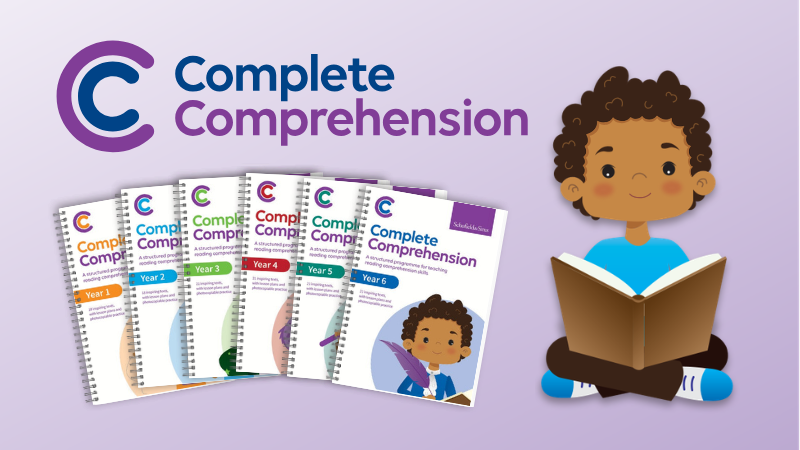
This post sets out what effective comprehension teaching looks like in primary schools, drawing on the approach behind Complete Comprehension, a whole-school programme for Years 1 to 6 developed by primary literacy specialists.
Why comprehension needs to be explicitly taught
There is a common assumption that comprehension develops naturally as children read more. In practice, without explicit teaching of the underlying skills, many pupils plateau. They can decode fluently but struggle to make inferences, identify the effect of language choices, or summarise what they have read. These are not instinctive abilities. These strategies must be modelled and practised until they become second nature.
The Reading Test Framework, which underpins KS1 and KS2 reading assessments, identifies nine distinct comprehension skills. Understanding these and knowing how to teach each one helps teachers to address gaps precisely, rather than relying on general reading practice to do the work.
The nine comprehension skills
The nine skills of the Reading Test Framework are not equally weighted. Retrieval, inference and word meaning are the cornerstones: the skills that appear most frequently in assessments and that underpin all the others. In Complete Comprehension, these three skills are the focus of multiple teaching units precisely because of how central they are to reading confidence. A strong comprehension curriculum ensures they are taught regularly and revisited across year groups, while also giving pupils experience of sequencing, summarising, predicting, analysing language, comparing texts and exploring relationships between ideas.
Effective teaching is not a matter of asking questions after reading. It requires teachers to model the metacognitive processes that skilled readers use: what they notice, what they wonder, what they infer and how they arrive at meaning. Showing pupils how to think about a text is as important as showing them what to think about it.
The role of text selection
Which texts you choose matters as much as how you teach. A strong comprehension curriculum exposes pupils to a wide range of forms: classic and contemporary fiction, non-fiction, poetry and non-literary prose. Each Complete Comprehension book includes up to 24 carefully chosen text passages drawn from across these categories, featuring authors including Katherine Rundell, Michael Morpurgo, Malorie Blackman, Abi Elphinstone and Pádraig Kenny. The breadth of the reading repertoire is deliberate: it builds the foundational word knowledge pupils need to access the wider curriculum and helps to develop reading for pleasure alongside reading for skill.
Paired texts are a particularly effective approach. In Complete Comprehension, passages are paired to prompt comparison-making and draw on background knowledge. For example, pairing a non-fiction text about castles with an Arthurian legend allows pupils to build knowledge in one text and apply and extend it in the other. Beyond paired texts, the series builds thematic links across each book through literary features, shared genres and cross-curricular themes, giving teachers natural opportunities to deepen pupils' wider knowledge through discussion.
Vocabulary as a foundation
Pupils who struggle with comprehension often struggle first with vocabulary. They can read the words on the page without accessing the meaning behind them. Pre-teaching key vocabulary before reading, and giving pupils strategies to unpick unfamiliar words in context, can make a significant difference to how much they understand.
This is especially important for disadvantaged pupils, who may come to school with a narrower vocabulary base than their peers. A comprehension curriculum that takes vocabulary seriously, embedding it within reading rather than treating it as a separate subject, helps to close the gap.
Reading for pleasure alongside reading for skill
Building reading skill and building a love of reading are not competing goals. Pupils who read for pleasure develop stronger comprehension over time simply by encountering more vocabulary, more text structures and more varied ways of using language. Schools that create time and space for reading for pleasure, and that help pupils see themselves as readers, are investing in comprehension outcomes even when no explicit teaching is taking place.
A whole-school approach
Comprehension teaching works best when it is consistent across year groups. If pupils encounter the same skills taught in the same way as they move through school, they can build progressively on what they already know. A patchwork of individual teachers' approaches, however well-intentioned, rarely produces the same results.
A whole-school programme gives school leaders a shared framework and gives teachers the subject knowledge, resources and lesson structure they need to teach comprehension confidently. It removes the burden of planning from scratch and ensures that every pupil, in every year group, receives teaching that is structured, progressive and aligned to the curriculum.
To support this consistency, the programme provides detailed lesson plans, modelling sessions, high-quality paired texts and photocopiable resources, giving teachers everything they need in one place.
-------------------------------------
Want to see it in action? Visit the Complete Comprehension series page to explore the books and request a free sample teaching unit for your year group. www.schofieldandsims.co.uk/school-programmes/complete-comprehension/