
WriteWell: what school leaders ask us most
Mon 18th May 2026
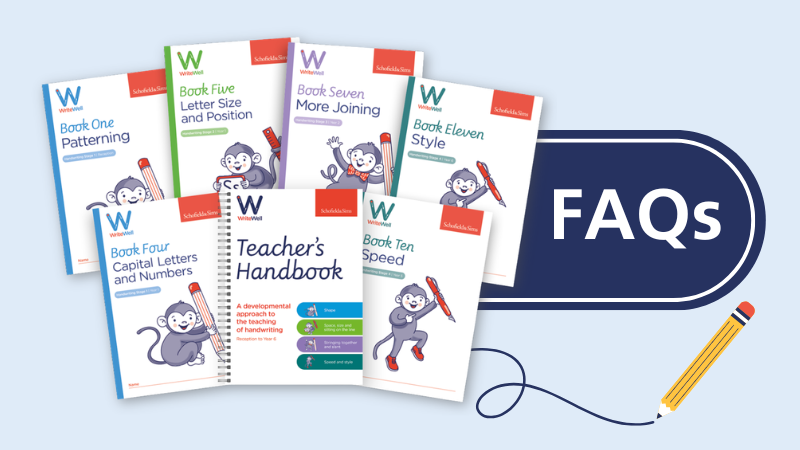
If you have recently requested a sample of the Schofield & Sims WriteWell handwriting scheme, you may still be weighing up whether it is the right fit for your school. Below, we answer the questions we hear most often from primary school leaders considering the programme.
What is WriteWell, and who is it aimed at?
WriteWell is a structured, whole-school handwriting scheme from Schofield & Sims, designed for primary schools from Reception to Year 6. The series consists of eleven pupil books and a teacher's handbook. It is built on the advice of the National Handwriting Association (NHA) and its S Factors for Success framework, which identifies eight features of successful handwriting: Shape, Space, Size, Sitting on the line, Stringing together, Slant, Speed and Style, arranged in order of developmental demand. The programme is designed to give school leaders a consistent, evidence-informed approach to handwriting that works across every year group.
What does the programme cover, and how is it structured?
WriteWell is organised into four developmental Stages, each one building on the last. Stage 1 covers letter formation and shape (Books 1 to 4); Stage 2 covers space, size and sitting on the line (Book 5); Stage 3 covers joining and slant (Books 6 to 9); and Stage 4 covers speed and personal style (Books 10 and 11). The Stages are cumulative: each must be secure before children move on to the next. This is an important structural principle. Encouraging children to develop speed before joining is established, for example, causes joining to break down.
Before Stage 1 begins, the programme emphasises physical readiness. Children need to develop the necessary muscle strength, gross- and fine-motor skills and visual perception before pencil grip and letter formation are introduced. The teacher's handbook includes guidance on writing readiness activities to support this pre-writing stage.
How does WriteWell align with the National Curriculum and the DfE Writing Framework?
Each of the eleven pupil books maps directly to National Curriculum requirements for a specific year group, from the Early Learning Goals in Reception through to the Year 6 expectations for fluent, legible and increasingly fast handwriting. The 2025 DfE Writing Framework reinforces the importance of transcription automaticity, the point at which handwriting no longer competes with composition for a child's working memory. WriteWell's cumulative, stage-based approach is designed to build that automaticity progressively.
What does a WriteWell teaching session look like?
Each pupil book contains fifteen teaching units. Every unit follows a consistent four-step teaching model: introducing the focus through a short, interactive session with demonstration; a "Try it" activity where children attempt the focus with plenty of support and scaffolding; a "Practise it" activity with less scaffolding to consolidate the skill; and an "Apply it" activity where children use their new handwriting skill in a realistic writing context, drawing on learning from another area of the English curriculum.
Individual schools decide how to organise and timetable sessions. The programme is designed to be used flexibly, whether with whole classes, small groups or individual pupils, and whether in short, frequent sessions or longer weekly ones.
How often should WriteWell be taught across the week?
The programme does not prescribe a fixed timetable, as the right approach will vary depending on the age of the pupils and the Stage of the programme. As a general principle, younger children tend to benefit from shorter, more frequent sessions, while older pupils may do better with two longer sessions each week. What matters most is regularity: handwriting is a movement skill, and consistent practice is more effective than occasional longer lessons.
What teacher support is included?
The teacher's handbook provides handwriting theory, guidance on best practice, detailed stage-by-stage teaching notes and comprehensive formation charts for every letter, join and pattern covered in the programme. It also includes dedicated guidance for left-handed pupils, addressing the specific challenges they face with letter formation and writing position.
Free handwriting animations are available to download from the Schofield & Sims website, covering the formation of every lowercase letter, capital letter, number and key join. These can be displayed on an interactive whiteboard or accessed by pupils on individual devices.
How does assessment work within WriteWell?
Assessment is built into every unit of the programme. After each activity type, teachers assess whether children have grasped the unit focus before moving on. Self-assessment and peer assessment are also built in, with children encouraged to compare their writing to the model and identify what to improve.
At the end of each developmental Stage, a Ready to Go assessment helps teachers judge whether children are ready to progress or need further consolidation. Writing analysis sheets, which draw on the P checks and S factors, support more formal summative assessment. Photocopiable intervention resources are also provided for each Stage, targeting common difficulties that may arise.
Is WriteWell suitable for all year groups?
Yes. WriteWell covers Reception through to Year 6, so schools can implement it consistently across the whole school rather than combining resources with different letter formation styles. Because each Stage builds on the previous one, children develop a coherent, progressive approach to handwriting from the outset. Schools can follow the developmental Stage structure, the National Curriculum year group alignment, or a combination of both, depending on what works best for their pupils.
We are currently using a different approach. How would a transition to WriteWell work?
Many schools adopt WriteWell having previously used another scheme. Because the programme is organised into clear developmental Stages with a full National Curriculum alignment chart, it is straightforward to identify the right entry point for children at any year group. A phased introduction, beginning with a single year group or key stage, is one practical approach. If you would like to discuss a transition plan specific to your school, a School Advisor will be glad to help.
We have received a sample. What would you recommend as a next step?
If you have had the opportunity to look through the sample and would like to discuss the series further, whether about whole-school implementation, year group coverage, assessment or placing an order, a School Advisor will be happy to help.
You can get in touch by email: post@schofieldandsims.co.uk or telephone: +44 (0) 1484 607080.