My Letters and Sounds
My Letters and Sounds is a comprehensive, fully supported resource that will enable your staff to deliver systematic, synthetic phonics instruction throughout Reception and Year 1.
My Letters and Sounds is a systematic synthetic phonics (SSP) programme, validated by the DfE and aligned to Letters and Sounds. Developed by expert authors, the scheme offers your staff everything they need to deliver effective phonics instruction, allowing teachers to concentrate on how to teach, rather than what to teach, and focus on the needs of their class.

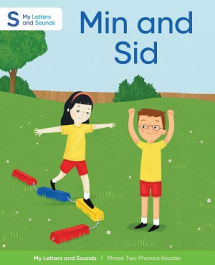
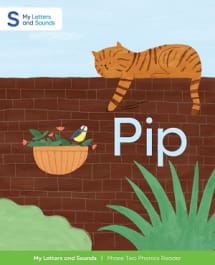
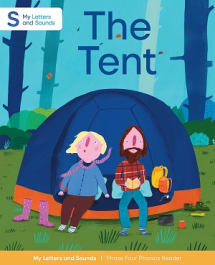
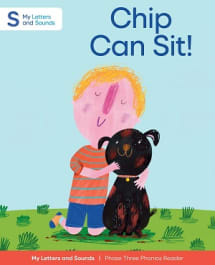
The e-reader library features digital versions of every Phonics Reader from the My Letters and Sounds programme. These electronic books are provided in a flexible and secure FlippingBook format that can easily be displayed on whiteboards, computer screens or tablets.
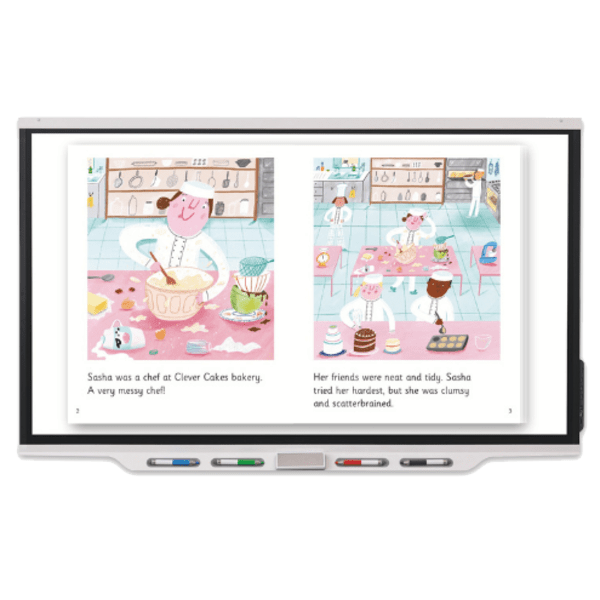
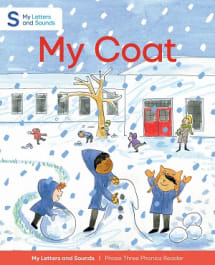
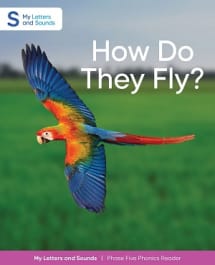
Read – 120 fiction and non-fiction decodable Phonics Readers are arranged in book bands and aligned to the 2007 Letters and Sounds progression, making them suitable for this scheme and many other Letters and Sounds SSPs. Save 50% with our cost-saving reader bundles.
Practise – a range of Reception and Year 1 workbooks help children practise phonics skills at home and in class.
Teach – help your staff teach with confidence using the Teacher's Handbooks with daily lesson plans and photocopiable resources. Physical versions of some of the most popular resources, including friezes and mnemonic flashcards, are also available.
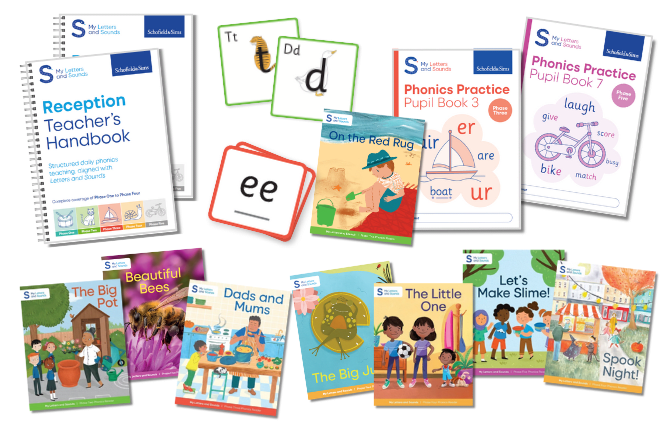
A variety of attractive, contemporary illustration styles give the readers the look and feel of real, high-quality children’s picture books. Written in natural language, with plenty of humour, the story texts focus on themes and experiences that will appeal to young children from a variety of different backgrounds.





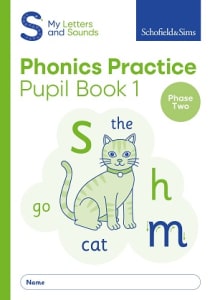
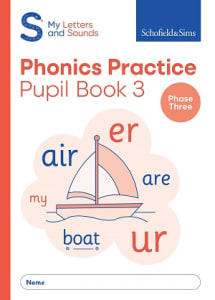
These write-in workbooks can be used at school or at home to practise the key phonics skills of grapheme recognition and recall, blending to read and segmenting to spell, and build children’s confidence in reading and writing captions and sentences.



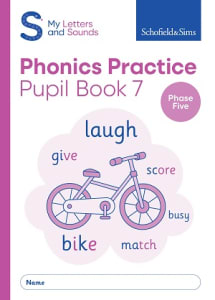

From Handbooks to friezes, choose from a wide range of phonics classroom resources. Many online resources are also available for free in the Free Downloads section of the Schofield and Sims website.



Search and filter through all Schofield and Sims products.
View all products

Yes, letter formation is taught when single-letter graphemes are first introduced using letter formation patters linked to the mnemonics. The Phase Two and Phase Three teaching guidance explains how to teach letter formation using a multi-sensory approach. Once children are confident forming the letter shape with their finger, they progress to writing the letter on paper or on the relevant spread of the corresponding Phonics Practice Pupil Book.
Teachers are encouraged to make additional time outside of phonics lessons to reinforce letter formation using activities provided in the teaching guidance and resources such as Letter formation practice sheets, which are available to download here. Formation of capital letters is not taught until Phase Three, so that children are not confused with lower-case letters. Again, letter formation patters and practice sheets are provided to reinforce capital letter formation outside of phonics lessons.
The letter formation practice in the Phonics Practice Pupil Books, on the letter formation practice sheets and on letter formation diagrams on the Mnemonics include clear starting points and directional arrows to support correct non-cursive letter formation.
While children are learning to form letters correctly, they are taught to segment and spell words using a phoneme frame and phoneme frame letters. Writing words is introduced gradually towards the end of Phase Two, where children might just be asked to write the last two letters to complete a word. In Phase Three, they progress to writing complete words consisting of learned GPCs. Similarly, writing sentences is introduced gradually in Phase Three. First, children write the last word in a sentence modelled by the teacher, then a two- and three-word caption and finally a short sentence. Sentences are dictated by the teacher so they are in line with children's phonics knowledge and contain tricky words so these are also practised regularly in sentences.
Ongoing formative assessment is at the heart of My Letters and Sounds. 'Assess' statements in the daily lesson plans help to focus teachers' observations on the children's learning in that session, highlighting any content that needs to be reinforced so that subsequent teaching can be adjusted.
A daily assessment schedule for each phase or term allows you to use 'snapshot' assessments of a different group of children during each phonics teaching session to monitor individual children's progress in the key areas of grapheme recognition and recall, blending to read and segmenting to spell. Grapheme recognition and recall group record sheets are provided where you can record which graphemes are secure for each child.
The programme also provides end-of-phase (or end-of-term) summative assessment to assess children's learning at that point and check progress against the expected standards. Assessment statements set out what children should be able to do at each point in the year and assessment checks linked to the main assessment statements are available to download here.
Children identified as having gaps in their knowledge, or specific skills they need to develop, should be given extra teaching time in the form of small-group or one-to-one specific separate interventions, while children who are making the slowest progress (for example, the lowest-attaining 20%) should be given extra practice to ensure they can keep up with the pace of learning in lessons. Guidance on providing both extra support, in the form of keeping up sessions, and targeted support in the form of strategies and activities to help secure some key phonics knowledge that children may not have grasped, can be downloaded from the Schofield & Sims website. These activities and interventions reuse activities and resources used in the main daily phonics session, and are designed to take a minimal amount of time for teachers or trained TAs to carry out.
The Phonics Practice Pupil Books can also be used to provide extra practice each day to reinforce and consolidate learning for all children, including those at risk of falling behind. The children might begin the activities at school and then complete them at home.
Although most of the Phase One content relates to the Nursery part of the EYFS, the Reception Teacher's Handbook does contain guidance and activities relating to Phase One. It is recommended that you use the Phase One activities during the first fortnight of the Reception year, while school routines are being established, to practise key skills such as oral blending and segmenting while the children are settling in.
In addition, there may be some children starting Reception who still need to develop their awareness of sound and these children will benefit from continued use of the Phase One activities. This work would be done alongside, rather than instead of, the formal daily teaching of phonics that begins in Reception. Children do not need to have mastered all the skills in Phase One before beginning Phase Two.
The Phase One activities are organised into seven aspects, starting with general sound discrimination and moving on to sounds found in words. However, this does not represent a fixed order to be worked through: the boundaries between these different aspects are flexible and will overlap.
The teaching guidance for Phase One provides a bank of activities for each aspect, which teachers can draw on when planning activities for groups of children. The activities for each aspect are divided into three strands:
The emphasis on developing speaking and listening skills and enlarging vocabulary is present in all of the activities, as these are crucial for future success in reading. This means many of the activities in Phase One fall within the Communication and Language area of the statutory framework for the EYFS (and the Early Learning Goals 'Listening, Attention and Understanding' and 'Speaking'). Children are taught about good listening and encouraged to talk about the activities, participate in discussion and take turns to contribute.
The activities are largely adult-led and often designed for small groups, as this provides opportunities for the children to talk at length and have purposeful conversations with teachers, as well as hearing and using new vocabulary.
There is also a strong focus on using story, rhyme, poetry and song. This helps develop the children's listening skills, language and awareness of sounds within words, and is, again, something that should continue throughout the Reception year.
My Letters and Sounds has been designed in such a way that streaming is not necessary. All children progress through the phonics content at the same pace in the daily phonics lessons. In line with the DfE's criteria for effective SSP programmes, specific guidance is given on providing smaller, more targeted activities and specific separate interventions for those children who struggle to grasp particular concepts or who generally struggle to keep up. These activities and interventions reuse activities and resources used in the main daily phonics session, and are designed to take a minimal amount of time for teachers or trained TAs to carry out.
For the most part, the progression of My Letters and Sounds matches that of the original Letters and Sounds. It follows the same phase structure and contains much of the same phonics content. The programme does however incorporate some additional content from the 2014 National Curriculum.
This progression is effective because it introduces the GPCs in a very specific order and allows for children to begin blending and segmenting within the first few weeks of starting phonics teaching in Reception.
The key differences between the My Letters and Sounds progression and the original Letters and Sounds progressions are:
The pace of My Letters and Sounds is similar to the original Letters and Sounds but not identical. This is because it incorporates more time for revision and consolidation. In Phases Two to Four, children usually learn four new GPCs per week as well as some tricky words. In Phase Five, the pace is slowed to three new GPCs per week to allow for the more demanding work being taught. In the original Letters and Sounds, they continued to learn four new GPCs per week in Phase Five.
Further details on the My Letters and Sounds Progression can be found in the My Letters and Sounds Progression Chart.
Tricky words, as they are referred to in My Letters and Sounds, are taught in a sequence based on how frequently they are likely to occur in texts children will encounter. The children first learn to read the tricky words, noting the part of a word that makes it tricky. Then, when they are familiar with reading the words, they learn to spell them. Some of the tricky words taught in Reception are no longer 'tricky' by Year 1, as the children have by then learnt the necessary GPCs.
Children learn to decode five tricky words in Phase Two (to, the, I, no, go). These words are necessary to make simple captions and sentences and so are important for early reading. The number of tricky words introduced at this stage is kept to a minimum, as children need to learn to rely on their knowledge of GPCs to decode words.
Children learn to decode 12 tricky words in Phase Three and 14 tricky words in Phase Four. In Phase Five, they learn to decode 43 tricky words they are likely to meet when reading. At this stage, children are able to take on board tricky words more easily, as they are more aware of alternative GPCs.
Children are taught to spell tricky words once they have had sufficient practice decoding the words and are able to read them automatically: once children are familiar with the tricky part from reading, it is easier for them to remember it for spelling. Children learn to spell four tricky words in Phase Three, 12 tricky words in Phase Four and 30 tricky words in Phase Five.
The My Letters and Sounds Progression Chart sets out the tricky words children are taught to decode each week and when they are taught to spell them. By the end of Phase Five, children will have learnt to decode and spell all the tricky words from the 'List of 100 high-frequency words' (Masterton, J., Stuart, M., Dixon, M. and Lovejoy, S. (2003) Children's Printed Word Database: Economic and Social Research Council funded project, R00023406 ). Words from the National Curriculum list of common exception words that were not included in the original Letters and Sounds are also included.
Yes, there are currently 120 My Letters and Sounds decodable readers available, with further readers in development. The Phonics Readers perfectly match the progression of the My Letters and Sounds programme and are designed to be used from the second week of Phase Two, allowing children to apply their phonics knowledge and skills to read 'real' books from a very early stage.
All the books feature high-quality illustration and photography and include helpful tips and activities on the inside front and back covers to support parents and other adults as they read the texts with children. Particular care has bee taken to use natural language that follows children's speech patterns as well as topics and settings that many children be able to relate to, incorporate rich, age-appropriate vocabulary to be enjoyed, discussed and explored.
A digital library containing all 110 books is available on an annual subscription (RRP £450.00 / Teacher price £240.00). The e-readers are provided in a flexible and secure FlippingBook format that can easily be shared via your school's VLE. Please contact our customer service team for more information.
The Phonics Readers should be read outside the daily phonics session to develop children's independent reading.
There are a variety of ways that the readers can be used depending on the setting and how the Phonics Lead chooses to organise reading. One option might be for children to read them with the class teacher or a trained teaching assistant one to one, or they could be used in small groups of up to six children who are at the same level in their phonics knowledge. They could also be sent home to allow children to practise reading with their parents and carers. You can find further suggestions for using the Phonics Readers in one-to-one or guided reading sessions in the Suggested ways to use the My Letters and Sounds Phonics Readers download here.
Children should read each book a number of times to help build up their fluency, their recognition of high-frequency words, and their confidence in word reading. In school they could reread the books with an adult to develop fluency and comprehension, then with a 'reading buddy' to secure their learning. You could collect books they have read in 'familiar reading' trays or displays, building up a range of books that children can read and reread in subsequent weeks. They could also take the books home to reread.
Although the focus is on word reading, you should always ask some simple questions to check whether children have understood what they have read. It is important for children to recognise that reading is not just about decoding words; it's also about understanding what those words mean in context. The Phonics Readers include sets of questions to ask before, during and after reading to encourage active reading and build comprehension skills.
Given the close alignment of My Letter and Sounds with the original Letters and Sounds progression, it may be possible to use the My Letters and Sounds Phonics Readers, and other elements of the programme, alongside another validated SSP or as part of your school's own programme, provided these are also based on the original Letters and Sounds progression.*
If your schools is already using a programme from the validated list that is not My Letters and Sounds and you are looking to supplement that programme with additional readers, we recommend that you consult the My Letters and Sounds Readers Phonics Coverage Chart to assess how closely the readers match your school's phonics programme in terms of the progression of GPCs and tricky words.
*Note: Schools receiving support through the English Hubs must follow a programme from the DfE's validated list.
The Phonics Practice Pupil Books provide additional opportunities for pupils to practise the key phonics skills of grapheme recognition and recall, blending to read and segmenting to spell, as well as building children's confidence in reading and writing captions and sentences. With a page or double-page spread for every new learning point in My Letters and Sounds, the books can be used flexibly, at school or at home, to consolidate the work done in the daily phonics session.
Since they are intended for use outside the main phonics sessions, it is possible to teach the core phonics knowledge and skills within the programme without using the Phonics Practice Pupil Books. However, in order to experience the full benefits of the programme, particularly with respect to supporting those children who need help to keep up with their peers, we do recommend that schools consider using the Phonics Practice Pupil Books with some, if not all, pupils.
In addition to the photocopiable resources provided in the Teacher's Handbooks, an extensive set of additional digital resources is available to download for each phase. These include:
All of the digital resources are free to download and do not require the creation of an account. You can find a complete list of the My Letters and Sounds digital resources here.
The My Letters and Sounds Classroom Kits provide over 1,000 durable, physical, colour versions of the core teaching and learning resources that are used frequently and repeatedly in lessons.
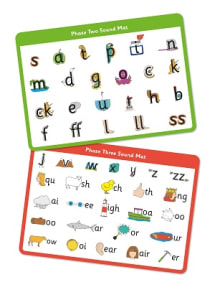
Sound Mats can be used for regular practise of grapheme recognition and recall, whilst large Friezes can be added to a colourful classroom display to show weekly grapheme-phoneme correspondences (GPCs). Hundreds of Grapheme Cards and Word Cards are included for use at the front of the class or for the children to post into Tog the Robot Posting Box. Wipe-clean Phoneme Frames can be used to demonstrate segmenting with letters. Mnemonics are included to introduce new GPCs and demonstrate correct letter formation, which is also supported by a Letter Formation Poster that acts as a clear and helpful reference for the whole class.
The My Letters and Sounds Teacher's Handbooks provide full guidance for teachers to support the effective delivery of the programme, both in the introductions and in the teaching guidance for each phase or term.
In addition, My Letters and Sounds is supported by high-quality and affordable training for schools that need help implementing the programme, upskilling staff and supporting the effective delivery of the programme. The training comprises four key sessions, each focusing on a different aspect of phonics teaching or the My Letters and Sounds programme. Schools may choose to receive all four training sessions or just one, two or three of the sessions. The sessions can be delivered on separate days (as 1.5-hour twilight sessions) or combined into half-days (3 hours) or full days (6 hours). Additional follow-up sessions, focusing on troubleshooting and improving impact, are available during the rolling-out of the programme. Bespoke sessions are also available upon request.
Training is always live so that teachers have the opportunity to ask questions and we offer flexibility in terms of whether it is delivered online or in-person. Further information on the content covered in each training session and pricing can be found here.
My Letters and Sounds provides a range of resources that are suitable for use at home, including Phonics Readers and Phonics Practice Pupil Books. Every effort has been made to ensure that these resources are as accessible and easy-to-use for parents and carers as possible.
In the case of the Phonics Readers, the inside front and inside back covers of the books include useful tips and activities to support parents and carers as they read the books with children. The GPCs and tricky words included in each book are listed so that children can practise reading them in advance of reading the text. Child-friendly definitions are provided for any unfamiliar vocabulary, so that these words can be discussed and explored prior to reading. Questions about the cover illustration and title help to introduce the text, while comprehension questions encourage children to talk about the story and check their understanding of what they have read.
It is important that all adults who listen to children read encourage them to apply their phonics knowledge and skills to decode the words. The free resource Reading at home: My Letters and Sounds Phonics Readers is available to download from the Schofield & Sims website and can be shared with parents and other adults to ensure a consistent approach.
General phonics guidance is also provided for parents in the form of 'Phonics practice at home' downloadable resources for both Reception and Year 1 that include helpful information on key phonics terms and practical ideas to help children practise their phonics at home.
Parents and carers wishing to use the resources as part of a home education programme should contact our customer service team for advice on how to implement My Letters and Sounds at home.
My Letters and Sounds is an affordable SSP programme, with transparent pricing that is fair to all schools. There is no complicated programme subscription model and schools can buy any quantity of books that they require at the same discounted Teacher price.
Based on the above prices, a typical school single-form entry Reception package (comprising one Teacher's Handbook; six sets of 75 Phonics Readers; 35 sets of four Phonics Practice Pupil Books) would cost £2,015.00 (RRP £3,100.50). A typical school single-form entry Year 1 package (comprising one Teacher's Handbook; six sets of 35 Phonics Readers; 35 sets of four Phonics Practice Pupil Books) would cost £1,415.00 (RRP £2,152.50).
My Letters and Sounds provides a range of multi-sensory resources and activities to support the introduction of new grapheme-phoneme correspondences (GPCs) and phonics skills, including:
Physical activities, such as writing letter shapes using a range of materials and textures, are included for use outside the daily phonics session. These activities have been carefully chosen to ensure that they are straightforward and quick to carry out, and that the primary focus is always on the phonics learning, rather than on the activity itself. There are also further suggestions for using toys and themed actions to reinforce learning in the teaching guidance.
Yes, My Letters and Sounds was submitted to the DfE's Validation Panel at the end of March 2022 and was judged to meet all the most recent DfE criteria for an effective SSP teaching programme. While there is no statutory requirement for schools to choose one of the validated SSP programmes, the DfE strongly recommends that schools consider using a programme from the approved list. You can view the full list of validated phonics programmes here.
Yes, My Letters and Sounds is a complete SSP programme providing all the teaching guidance, daily lesson plans and resources needed to teach systematic synthetic phonics (SSP) to children throughout Reception and Year 1.
The programme retains the phase structure of the original Letters and Sounds progression, but the phases are linked to the school terms to help ensure that children meet or exceed the expected standard in the Year 1 Phonics Screening Check and all Early Years Foundation Stage (EYFS) and National Curriculum expectations for word reading through decoding by the end of Key Stage 1.
Explore the My Letters and Sounds programme further by requesting a free information pack by email. The pack will include access to a digital library of books and resources from across the scheme, along with further information about how My Letters and Sounds can help your school.